Internal help desk vs customer help desk: what changes
How an internal help desk differs from a customer help desk: directory identity, approvals, confidentiality, business-hours SLAs, and audit requirements.
- Published
- Updated
- Reading time
- 7 min
- By
- EvenTier
A customer help desk and an internal help desk look similar. Both have a queue, agents, statuses, SLAs, and a knowledge base, and most products in the category were made for customer support and later sold for internal use. The differences are in who the requester is, what they can ask for, and who needs to prove what happened afterward. Those differences decide which features matter, and they are the ones to test before you choose a tool.
This guide lists what changes and how EvenTier handles each difference. It is written for the IT or operations lead who runs a customer support tool as an internal help desk and is deciding whether to keep doing so.
Requesters have a directory identity
A customer is identified by an email address. An employee is a record in your directory, with a manager, a department, a start date, and an account that will eventually be deactivated. An internal help desk should know all of this without asking.
Single sign-on (SSO) and user provisioning are the first features to check. Without them, every requester is a self-registered account. EvenTier signs people in through SAML 2.0 or OIDC with your identity provider (IdP), provisions and deprovisions them through SCIM 2.0, and imports profile photos from the same sources, so the agent sees a colleague's name, photo, and department. The single sign-on documentation covers the setup. Requesters are unlimited and free. This matters because a customer support tool that charges per agent and treats every employee as a contact becomes expensive quickly.
Identity also drives routing. A request from someone in Finance can go to the finance queue based on the directory, and an automation rule can match on the requester's department.
Approvals are part of the request
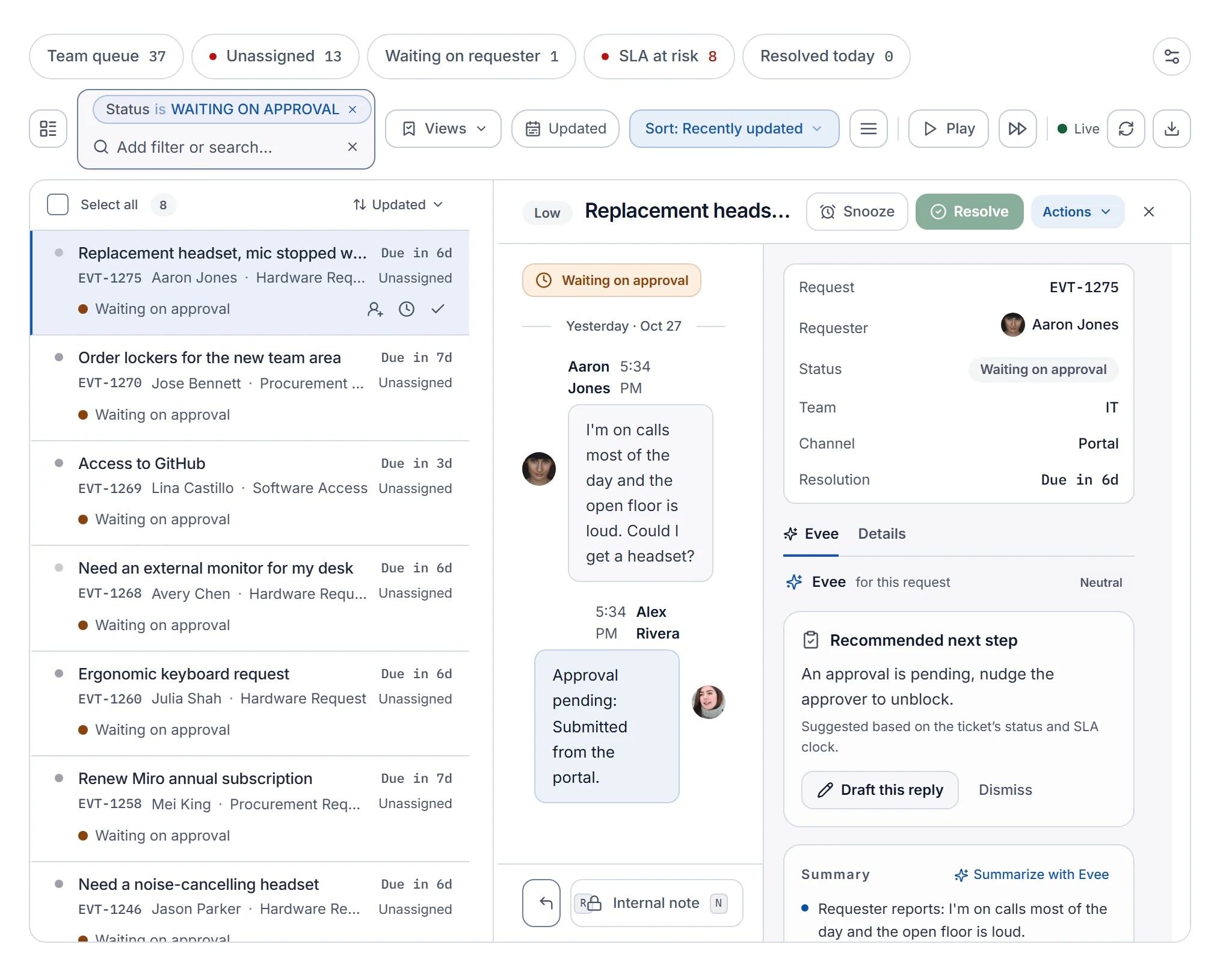
Customer support rarely needs a manager to approve a ticket. Internal support needs approvals constantly: a laptop, an admin role, a software license, a purchase, a new hire's equipment. In a customer support tool, the approval often happens in an email thread outside the ticket or through a marketplace add-on, and the decision ends up in someone's mailbox.
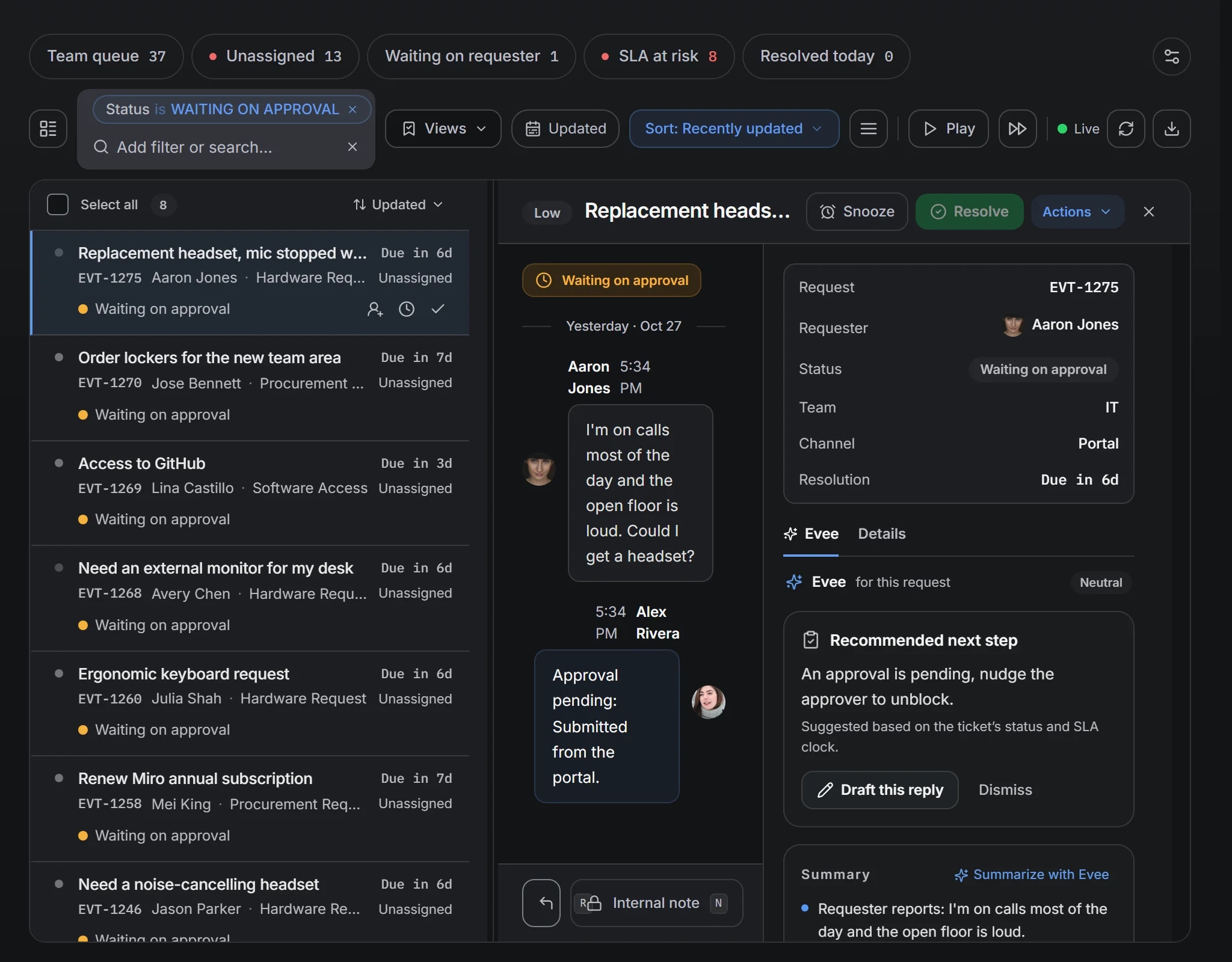
An internal help desk treats approval as a status the request moves through. In EvenTier, each request type has an Approval required setting. A request of that type goes to a single approver or an ordered chain of approvers, waits in the Waiting on approval status, and moves on when they decide. The decision is recorded in the audit log. Approvers can delegate for a date range when they are away, and the SLA clock pauses during the wait if the policy allows it. The approval workflow examples cover hardware, access, onboarding, and spend.
Some requests are confidential
A customer ticket is visible to the whole support team by design. An internal help desk handles HR grievances, salary questions, legal intake, and access requests that name systems and roles. The list of who asked for what is sensitive, and a shared queue where any agent can open any request is a risk.
EvenTier sets confidentiality per request type, as Never, Requester chooses or Always confidential. A confidential request is visible only to the requester, the assignee and watchers, the team it is routed to, explicit grantees, and the approvers. The server applies the restriction regardless of what the intake form sends, and it is enforced in the queue, analytics, notifications, the REST API, and every Evee feature, so a confidential request does not appear in a dashboard or a summary. For HR and legal request types, choose Always confidential.
One portal for every department
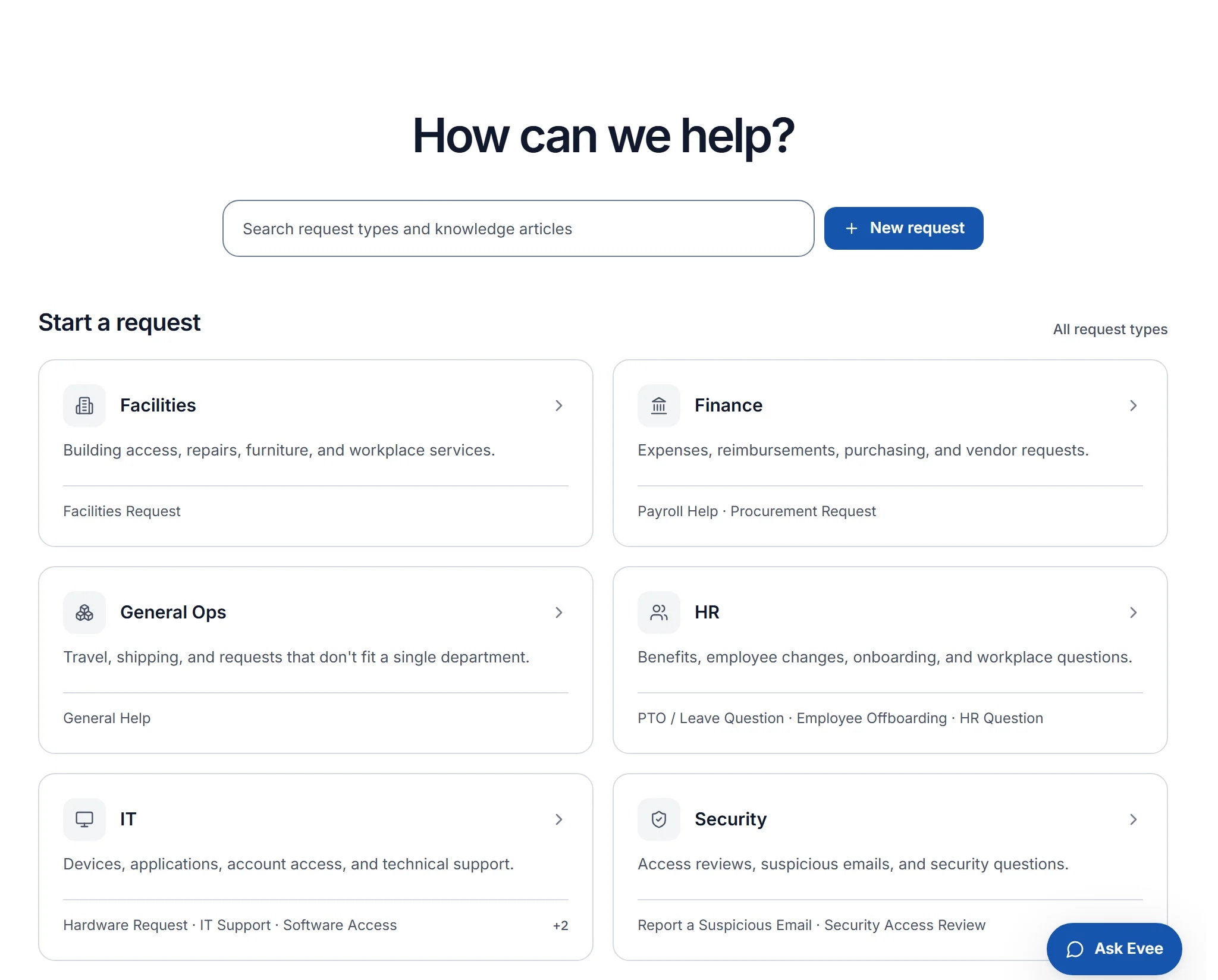
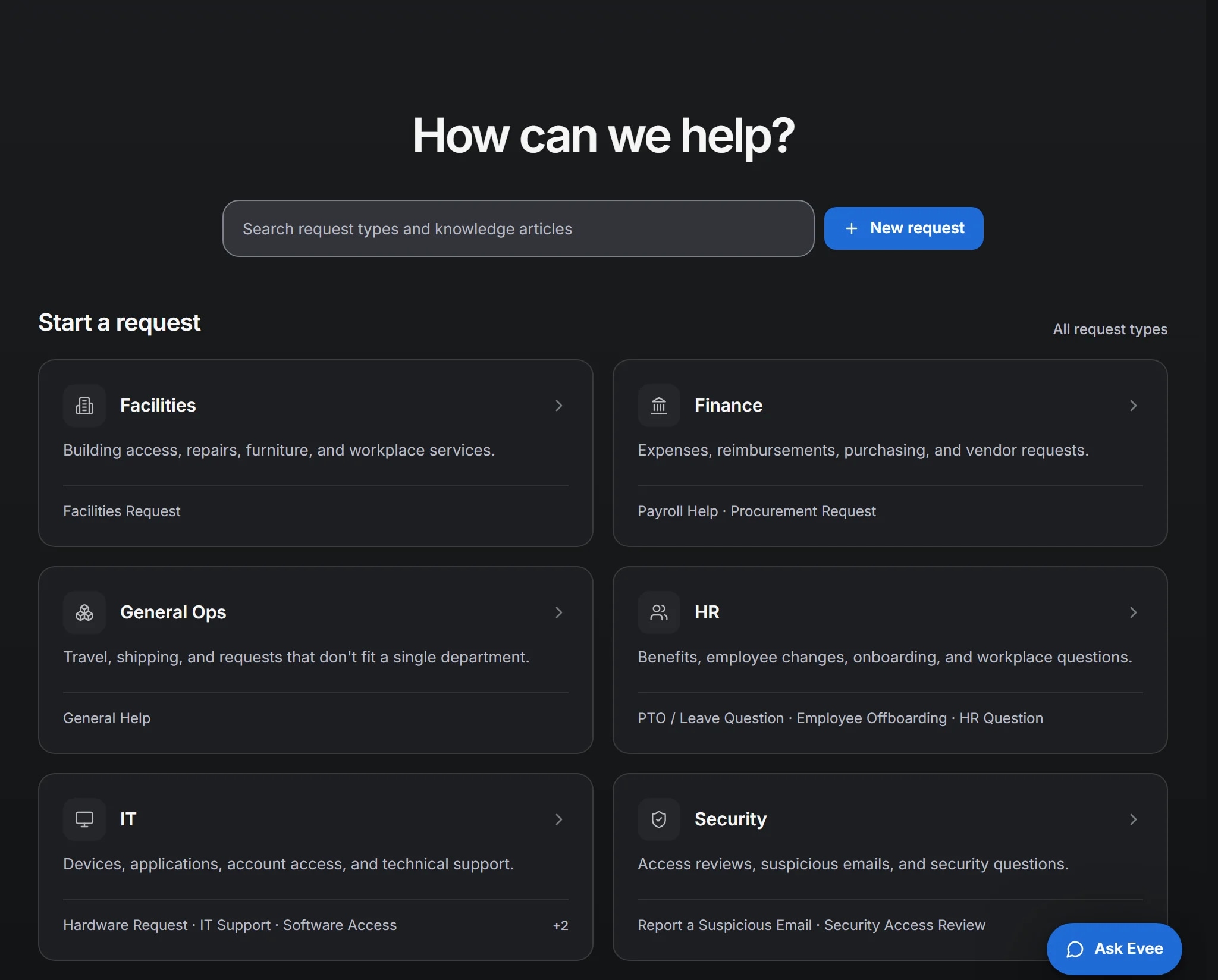
A customer help desk serves one audience with one catalog. An internal help desk serves every department, and the first question employees have is where to ask. If IT, HR, finance, and facilities each run their own tool, employees have to know four addresses and guess which one applies.
The internal model is one portal with a catalog organized by team. ITIL 4 calls these service requests: predefined requests that employees start and a team fulfils, each with a known form and owner. Each request type has its own form, owning team, approval setting, and SLA policy. An employee chooses the request type, the form asks for the fields that type needs, and the request arrives in the right queue with the right fields filled in. The employee request management page shows how the catalog is laid out.
SLA clocks follow business hours
A customer SLA usually runs around the clock, because customers are in every time zone and a response time was part of the contract. An internal SLA runs during working hours, pauses while the requester is away, and pauses while a manager decides. Otherwise the metric measures other people's calendars and reports the result as IT's performance.
Business-hours schedules, per-policy pause statuses, and escalations that fire once per request are the features to test. The SLA policy template gives a starting configuration and the reasoning behind each number.
Audit requirements
A customer help desk is measured on customer satisfaction. An internal help desk is audited for control: who approved the admin role, who changed the request's priority, who signed in from where, and whether the vendor's own staff ever opened the workspace. The security questionnaire you complete before buying an internal tool asks about all of this, and each answer should point to a product feature.
EvenTier keeps three logs (a change log, a sign-in log, and a security log) and streams all three to a SIEM, including EvenTier staff access to the workspace. Custom roles are built from individual permissions and scoped to teams. Sign-in can be restricted to your network ranges. GDPR erasure and data access exports are built-in, audited actions. The trust page lists the security controls, including the ones not yet available. The guide to what an audit log must record explains how to read the logs.
Knowledge base and Evee
Customer help centers reduce tickets by being public. An internal knowledge base reduces tickets by appearing at the right moment. When an employee is about to file a password reset request, the article that answers it should appear in the portal before they submit.
EvenTier's knowledge base is searchable from the portal, with a Draft, Review, Published workflow and versions you can revert. Evee answers employees in the portal from the published articles, cites its sources, and prefills a request for the employee to review before it is filed. For agents, Evee drafts replies and proposes status, priority, and assignment changes as cards the agent applies or dismisses. Nothing happens without a person's action, and confidential requests are not sent to the AI provider unless an admin allows it.
What customer tools do better
Customer support tools have broader intake channels, including social messaging and chat widgets that an internal help desk rarely needs. They have larger marketplaces and long-standing integrations with CRM and billing systems. Their reporting focuses on customer satisfaction and agent productivity at high volume. If your requesters are paying customers at volume, that is the category to buy from, and the comparison pages say so where it applies.
EvenTier takes requests from the portal, by email and through the REST API. It has no chat widget or social channels. For an internal help desk behind SSO the portal is usually what you want, since every request arrives with a request type and a known requester, but it is a difference to know about before you move.
Evaluation checklist
Ask these questions of any tool you are considering as an internal help desk. Each answer should be a product feature.
- Can employees sign in through our identity provider, and are they provisioned and deprovisioned automatically?
- Is approval a status a request moves through, with a named approver, delegation, and an audit log entry?
- Can a request type be confidential, and is the restriction enforced everywhere the request appears, including analytics and AI?
- Can IT, HR, finance, and facilities share one portal with their own forms, routing, and SLAs?
- Do SLA clocks follow business hours and pause on requester and approval waits?
- Are there separate change, sign-in, and security logs, and can they stream to our SIEM?
- Are the security and audit features included on the plan we would buy?
The last question decides most migrations. An internal help desk needs these controls, so the plan that includes them sets the real price of the tool. If you are moving, see migrating from Zendesk without losing ticket history.
References
- ITIL 4 Practitioner: Service Request ManagementPeopleCert (ITIL). The ITIL 4 practice for predefined, user-initiated requests, the core of an internal help desk.
- Assertions and Protocols for the OASIS Security Assertion Markup Language (SAML) V2.0OASIS. The SAML 2.0 core specification used for single sign-on.
- OpenID Connect Core 1.0OpenID Foundation. The OIDC specification, the other common single sign-on protocol.
- System for Cross-domain Identity Management: Protocol (RFC 7644)IETF. The SCIM 2.0 protocol identity providers use to provision and deprovision accounts.
Filed under service-desk, internal-it.